
What About Your Future Self?
Benjamin Hardy’s Be Your Future Self Now

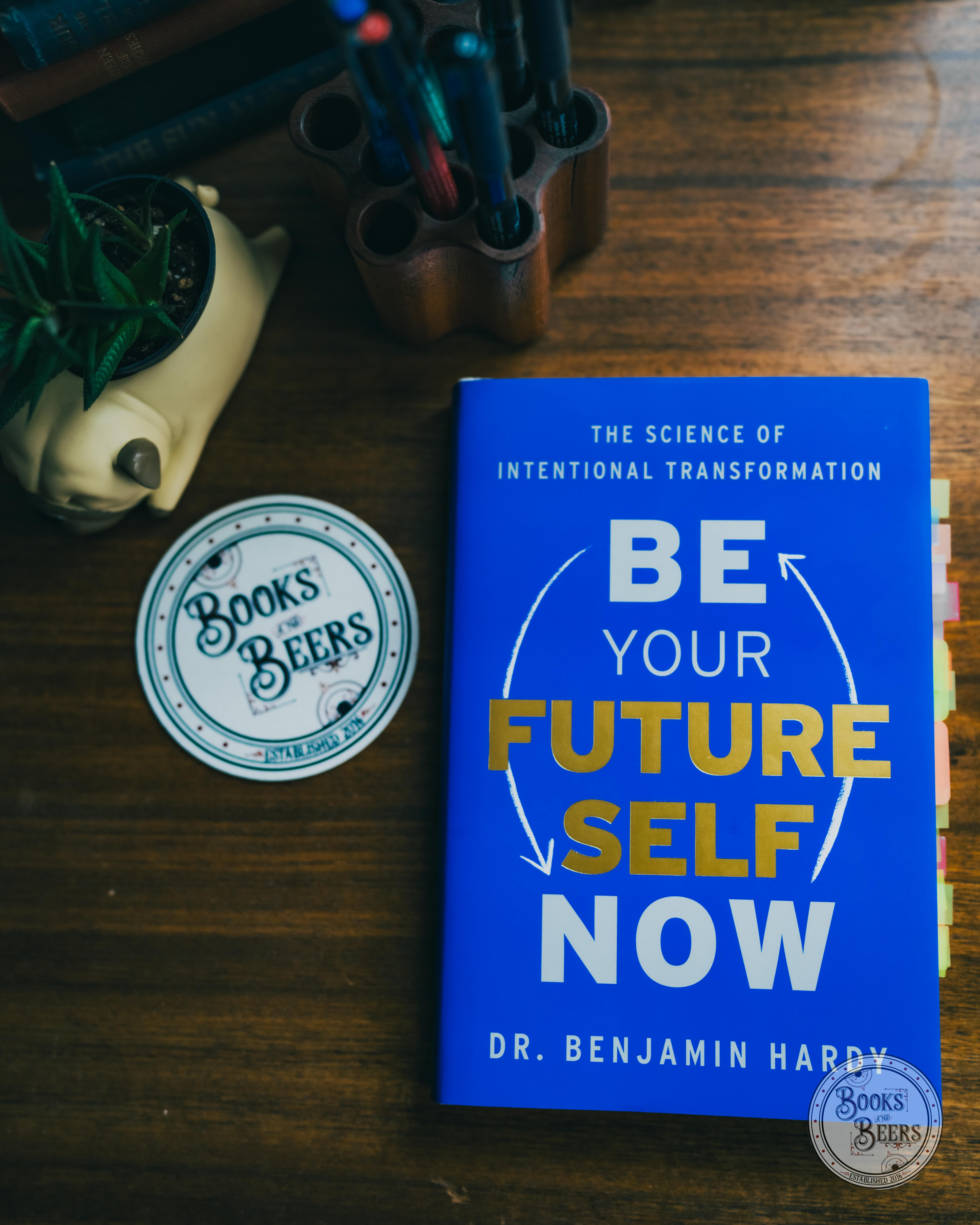
What if I were to tell you that your past does not drive or dictate your actions and behaviours; would you believe me? Would you consider that it's, in fact, your future that pulls you forward versus your past that pushes you? It's an interesting perspective when looking at our lives, as Dr. Benjamin Hardy distills this idea in his book Be Your Future Self Now, which I recently read to reinvigorate my goal-setting ideas.
"As human beings, we have a unique characteristic held by no other species on the planet. People have the ability to not only think about their own future, but to have countless potential scenarios for our future."
We often set goals, but perhaps we don't spend enough time thinking about our Future Self and who we hope to become. We set a goal for the next 30 days or the following year, but how about in five or ten years? Hardy quotes a great passage from Robert Greene and 50 Cent's The 50th Law and notes: "It is a law of power, however, that the further and deeper we contemplate the future, the greater our capacity to shape it to our desires."
I'm guilty of thinking short-term and often not linking that to my future self. I do a weekly recap every Sunday, but I rarely think about how it ties into my life 2,5 or 10 years out. Take a moment to think about yourself in 10 years. What do you see? What kind of life are you living? As we build out those future views of ourselves, we can start to line up our short-term goals so that things we do today are steps along a path to what we hope to achieve.
"The quality of connection you have with your own Future Self determines the quality of your life and behaviors now. Contemplating your Future Self, you're more likely to invest in and set yourself up for an abundant retirement, exercise and eat healthier, and you're less likely to engage in delinquent or self-defeating acts."
Hardy's book breaks down the idea of the Future Self by first focusing on what can derail us before moving on to what is true about our Future Self and the steps we can take to achieve those future goals. Common threats include not having any hope in your future, not recognizing the importance of your environment in maintaining the stability of goals, and not taking the steps of actually getting into the arena. There has to be a willingness to challenge ourselves, and often, we are unwilling to do so.
Hardy quotes Austrian psychiatrist and Holocaust survivor Viktor Frankl: "A man who let himself decline because he could not see any future goal found himself occupied with retrospective thoughts. Instead of taking the camp's difficulties as a test of their inner strength, they did not take their life seriously and despised it as something of no consequence. They preferred to close their eyes and to live in the past. Life for such people became meaningless."
We have these ideas about our Future Self; Hardy walks us through the fallacies and truths, but now what? Hardy lays out steps we can all follow if we are willing to put in the work and spend the time doing so. Hardy references the idea of a contextual purpose, a specific goal or purpose in the here and now. We often get bogged down in not knowing our purpose; we look too far out and perhaps don't know right now. So what if we shorten the time frame? A contextual purpose shortens things so that we can say, "This is what my purpose is for the next year, two years, and five years." "Define for yourself a contextual purpose that you believe to be the absolute most important thing you can do right now."
Another area that I appreciated about Hardy's book was his focus on lesser goals. He quotes Robert Brault with this gem: "We are kept from our goal not by obstacles, but by a clear path to a lesser goal."
What a great quote! It is easy to recognize when you realize that we often set lofty goals, perhaps achieve a moderate level of success, and then get derailed from those lofty goals because we've achieved lesser goals. We settle, in other words. How does this manifest for me? An easy one is in the minutiae of work I can pile up around me to avoid the actual work I want to be doing.
Let's say I want to write a blog post, and then I spend time planning, making notes, reading, maybe doing a social media post, and making a list of things I need to do. A coffee sounds great, and oh, I better check my email again with one last check of Instagram. I've now created a bunch of lesser goals without having focused on the task at hand.
Now, if you set a 10x goal and achieve 5x, that may be great. Most of us don't aim that high (I'm guilty of this), so the lesser goal is not 5x but perhaps 0.1x.
"Lesser goals are weeds in the garden of life. Every time you engage in a lesser goal, it's the equivalent of planting a weed in your garden. Whatever you plant will produce your results." What a great analogy and one more quote because I also appreciated Hardy for this one.
"Your results follow what you're most committed to in a single instant. The easiest way to see what you're committed to is by observing your own behavior. If you're trying to work on a project, but continually distract yourself with other things, than you're committed to the distractions. The distractions are the greater goal in that moment."
Hardy has written a compelling book that tends to speak to me. Give me tactical ideas, keep me focused, and make it value-add. There are a lot of great tips in this one that anyone can benefit from. You may have heard a lot of this stuff before, but a reminder never hurts (unless you are reading this blog post and this book as part of your lesser goal!).